A purified water system pharmaceutical manufacturers can rely on is the backbone of every liquid dosage form, cleaning regimen, and media preparation step in the plant. Selecting one is not simply a matter of picking a reverse osmosis skid — the choice depends on the compendial grade your product requires, the feed water available at your site, how you intend to sanitize the loop, and the documentation your quality unit must defend during inspection.
HIGHFINE PHARMATECH CO., LTD has been building pharmaceutical water and process equipment since 1992 from its manufacturing base at No. 379 Zhonghua East Road, Haimen City, Jiangsu Province, China. This page outlines the selection logic behind our purified water, ultrapure water, and industrial RO purification routes so that engineering and procurement teams can shortlist a configuration before requesting a formal proposal.
Which Water Grade Does Your Process Need?
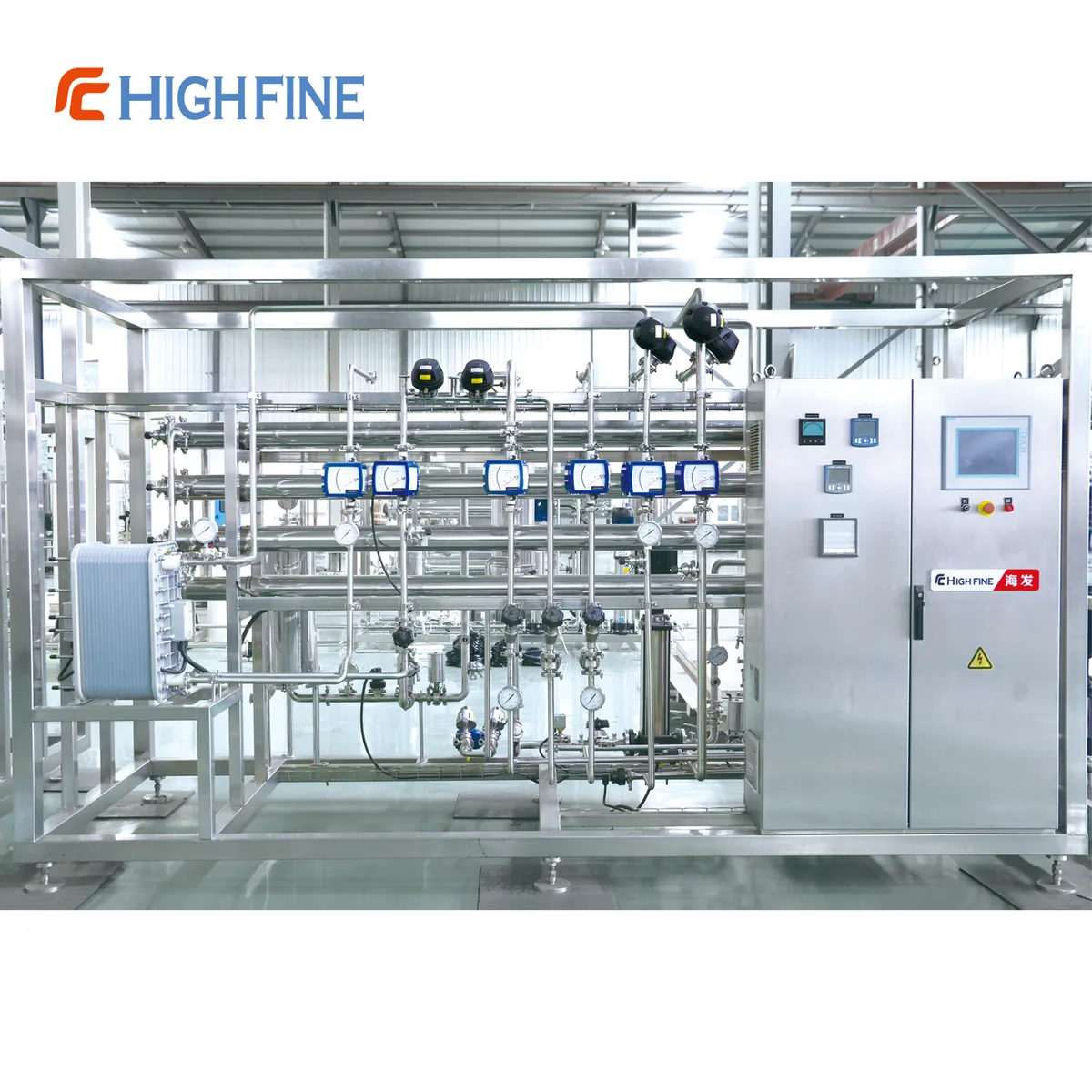
Pharmacopeial monographs separate water grades by use, not by cleverness of the equipment. Getting the grade wrong is the most expensive mistake in a water project, because it drives the entire process train, the storage and distribution design, and the validation package.
Purified Water (PW)
- The default grade for oral solid and oral liquid dosage forms, topical products, and equipment cleaning where WFI is not mandated.
- Produced by reverse osmosis, distillation, deionization, or other suitable processes, and controlled for conductivity, total organic carbon, and microbial bioburden per USP, EP, JP, or China Pharmacopoeia requirements.
- Typically stored and circulated in a sanitizable loop rather than generated on demand at each use point.
Water for Injection (WFI)
- Required for parenteral products, sterile irrigation, and certain ophthalmic preparations.
- Tightened endotoxin and microbial expectations compared with PW; the distribution loop must be continuously circulated and sanitized on a defined schedule.
- Where a plant runs both grades, PW is often the economical feed for the WFI generator — which is why a stable, well-controlled PW system matters even on injectable sites.
Ultrapure Water
- Used where ionic and organic load must be held to very low levels, such as certain biotech buffers, reagent preparation, and high-sensitivity analytical laboratories.
- A two-stage RO plus EDI train is the usual route when the specification is tight on conductivity, TOC, and microbial counts simultaneously.
What Goes Into a Pharmaceutical PW Process Train
Most purified water system pharmaceutical trains are assembled from the same functional blocks. The differences between suppliers appear in how those blocks are integrated, instrumented, and documented.
- Pretreatment — multimedia filtration, softening, and carbon adsorption protect downstream membranes from turbidity, hardness, and oxidants; pretreatment design follows the local feed water analysis.
- Reverse osmosis — semi-permeable membranes remove dissolved solids, ions, and contaminants under pressure; RO is the workhorse stage for ionic rejection and microbial reduction.
- Electrodeionization (EDI) — continuous polishing that replaces traditional mixed-bed ion exchange, removing the need for chemical regeneration of resins.
- Storage and distribution — a sanitizable tank and circulating loop with hygienic fittings, sampling points, and instruments that support your monitoring program.
- Sanitization — hot water or chemical, selected according to loop materials, use-point count, and operator preference.
Product Routes Compared
| Route | Core technology | Typical fit | Notable points from our range |
|---|---|---|---|
| Hot water disinfection purification water system | RO-based PW generation with automated hot water sanitization | PW loops where chemical-free sanitization is preferred | Automated hot water disinfection; meets China Pharmacopoeia and FDA requirements; 316L/SUS304 pipeline construction; chemical-free operation; concentrate water recycling |
| RO+EDI ultrapure water system | Combined RO and EDI | Ultrapure duty replacing aging ion exchange plants | Produces 15 megohm-cm ultrapure water; replaces traditional ion exchange; 30% lower operating costs |
| Two-stage RO+EDI ultrapure water system | Dual RO stages plus EDI | Demanding specifications where single-pass RO is not enough | Meets stringent standards of <=0.1 microS/cm conductivity, <=100 ppb TOC, and <=20 cfu/mL |
| Industrial RO water purification system | Advanced reverse osmosis | High-purity industrial process water at scale | Removes dissolved solids, ions, and contaminants through semi-permeable membranes under pressure |
Sanitization Strategy: Hot Water or Chemical
Sanitization is where many PW projects are won or lost in the audit. Both approaches are defensible; the choice should be deliberate.
Hot water disinfection uses the loop's own heat exchanger to raise the circulating water to a sanitizing temperature on a validated cycle. It leaves no chemical residue to rinse, which simplifies cleaning validation, and reduces the consumables and effluent load associated with chemical sanitants. Our hot water disinfection purification water system automates the cycle so that sanitization, cooldown, and return to service follow a repeatable sequence rather than an operator's memory.
Chemical sanitization remains appropriate in some retrofits and in loops where heat exchangers or certain components are not rated for thermal cycling. It demands defined rinse endpoints, residue testing, and careful handling procedures.
For new builds where the loop is designed from the start, hot water sanitization is usually the lower-risk choice for a purified water system pharmaceutical teams must operate for the next decade.
Materials and Hygienic Design
Product contact surfaces in our PW and ultrapure routes are constructed in 316L stainless steel, with SUS304 used for non-product-contact and structural elements. Hygienic design principles — full drainability, minimized dead legs, orbital welding with documentation, surface finish appropriate to the service, and slope toward drain points — are applied to tanks, piping, and fittings alike. Elastomers and diaphragms are selected for compatibility with the sanitization regime.
Compliance and Documentation
Our water systems are designed for GMP/USP/EP/FDA compliance, and our hot water disinfection route is described by the company as meeting China Pharmacopoeia and FDA requirements. Certificates available upon request. Documentation packages, material certificates, weld logs, and instrumentation calibration records are provided to support IQ/OQ and your internal validation program; the exact scope is confirmed at the proposal stage according to your quality unit's requirements.
Buyer Checklist
Before requesting a quote, gather the following so that the configuration can be fixed in one pass:
- Required compendial grade and the pharmacopeia under which you release product.
- Feed water analysis, including seasonal variation, and pretreatment already installed.
- Peak and average demand, plus cleaning and sanitization water volumes.
- Distribution loop layout: use-point count, distances, and whether the loop is new or existing.
- Preferred sanitization method and any temperature constraints on loop components.
- Storage tank size, material, and vent/filter philosophy.
- Documentation and validation deliverables expected at FAT, SAT, and handover.
- Utility availability and floor space for the skid, plus service access requirements.
FAQ
Can one system supply both PW and ultrapure water?
Usually the economical answer is a staged arrangement: PW generated and stored for general use, with a polishing RO+EDI stage feeding the points that need ultrapure quality. This avoids over-treating the whole plant's water.
Is EDI maintenance-free compared with ion exchange?
No technology is maintenance-free. The practical difference is that EDI eliminates the chemical regeneration step and the associated handling, storage, and effluent — which is what drives the 30% lower operating costs cited for our RO+EDI route.
How do I decide between single-stage and two-stage RO?
Base it on the required specification and the feed water. Where the target is <=0.1 microS/cm conductivity, <=100 ppb TOC, and <=20 cfu/mL, the two-stage RO+EDI configuration is the appropriate route. A feed water analysis is essential before either is fixed.
Does hot water sanitization replace routine microbial monitoring?
No. Sanitization is one control in a validated program that still includes sampling, trend analysis, and periodic review. Hot water disinfection reduces reliance on chemical agents; it does not remove monitoring obligations.
What documentation comes with the system?
Documentation is scoped to the project. Certificates available upon request, and the validation package is agreed at proposal stage against your quality unit's expectations for GMP/USP/EP/FDA compliance.
How long has HIGHFINE been building pharmaceutical water systems?
Since 1992. Current manufacturing scale and installed base details are as stated on the company website.
Next Step
Send us your water grade, feed analysis, and loop layout, and we will return a configuration with the appropriate process train, sanitization strategy, and material specification.
Get a System QuoteTalk to a Water System Engineer
Start the conversation
Get a System Quote
Send your URS; our engineers reply with a P&ID-level proposal.