Water for Injection is the most critical utility in a sterile pharmaceutical facility. It is the last process fluid to touch a product before it is sealed, and it is the one utility that cannot be corrected downstream. A WFI water system therefore has to be specified as an integrated train — generation, storage, distribution and sanitization — rather than as a collection of separate skids. HIGHFINE PHARMATECH CO., LTD has been building that train since 1992 from its manufacturing base in Haimen, Nantong, Jiangsu, China, for pharmaceutical plants across Southeast Asia, the Middle East, Africa, Europe and the Americas.
Generation Technologies: Multi-Effect vs. Vapor Compression Distillation
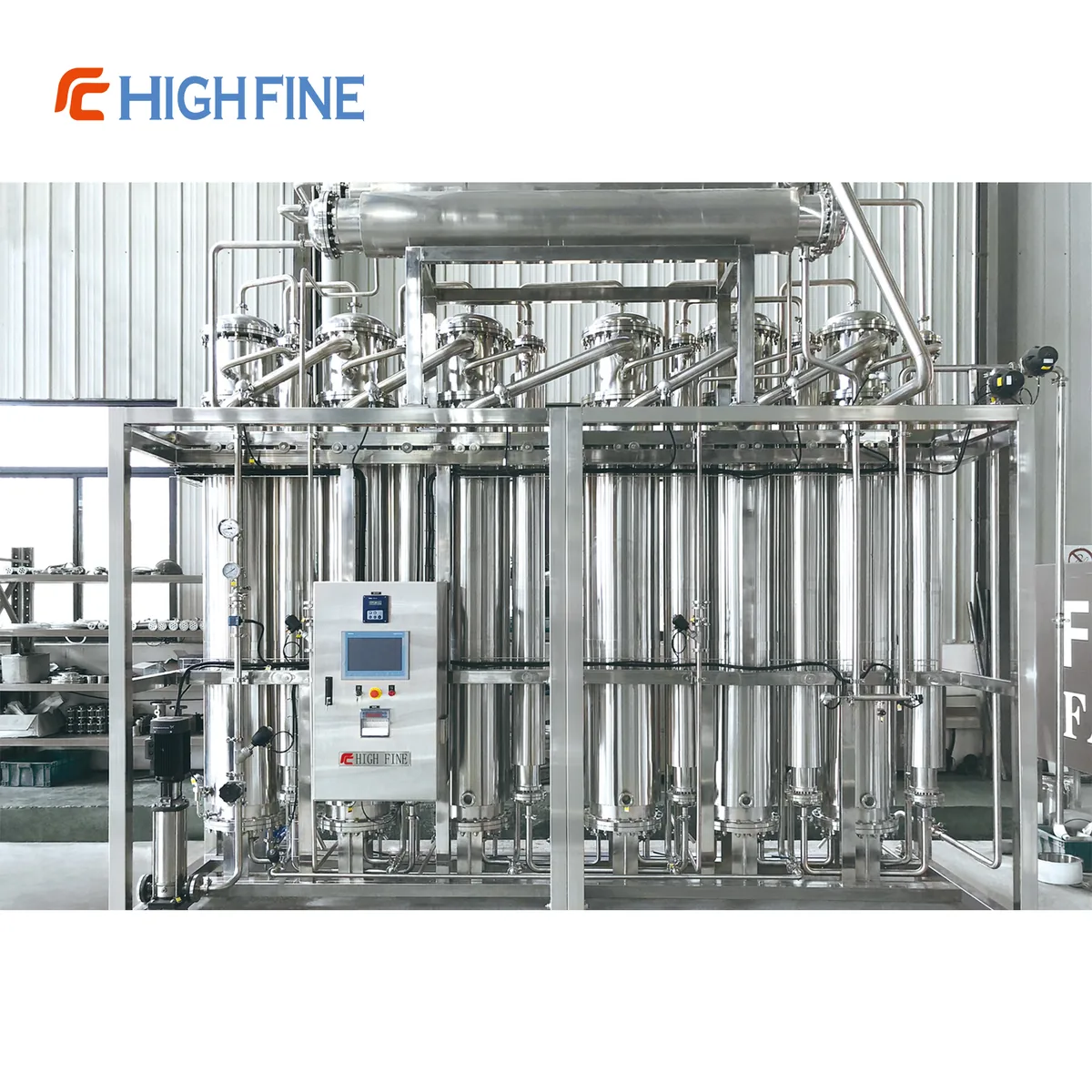
Distillation remains the reference technology for WFI because the phase change itself removes endotoxins, particulates and dissolved impurities. Two configurations dominate, and the choice between them is driven by your steam balance, your capacity profile and your product portfolio.
Multi-effect distillation uses the latent heat of one effect to drive the next, so steam economy improves as effects are added. HIGHFINE builds three multi-effect families:
- B-Series — rising-film evaporation with 100% heat transfer, producing pyrogen-free distillate. Precise feed-water distribution delivers a 20% steam saving, and the unit uses maintenance-free diversion.
- F-Series — Siemens S7 control system, Level 3 centrifugal separation and continuous gas/liquid discharge. The F-Series is supplied with FAT validation and is built for cGMP compliance.
- S-Series — falling-film evaporation in 316L stainless steel, with 0.6 micrometer Ra mirror-polished pipelines. Cascaded thermal reuse saves 20% steam. The S-Series is fully compliant with USP and EP requirements and is delivered with full validation documentation.
Vapor compression distillation removes the need for a large external steam supply by recompressing the vapor generated in the evaporator. HIGHFINE's vapor compression distiller is GMP-compliant and produces USP/EP-grade WFI at 0.05 microS/cm conductivity. It delivers 70% steam savings versus conventional distillers, achieves a 3-log endotoxin reduction, and is designed for low-pressure operation. It is particularly suited to vaccine and cell culture applications, where utility stability and low thermal stress matter. The design carries a validated 30-year lifespan as stated on the company website.
Choosing Between the Two Routes
Multi-effect distillation is usually the right answer where plant steam is already available and a conventional, well-understood utility architecture is preferred. Vapor compression is attractive where steam is scarce, expensive or intermittent, and where the electrical supply can support the compressor. In practice, few buyers choose on technology alone; they choose on total operating cost over a defined asset life, and on how easily the chosen route fits the existing cleanroom and plant-room layout.
Storage and Distribution: The Half of the System That Gets Overlooked
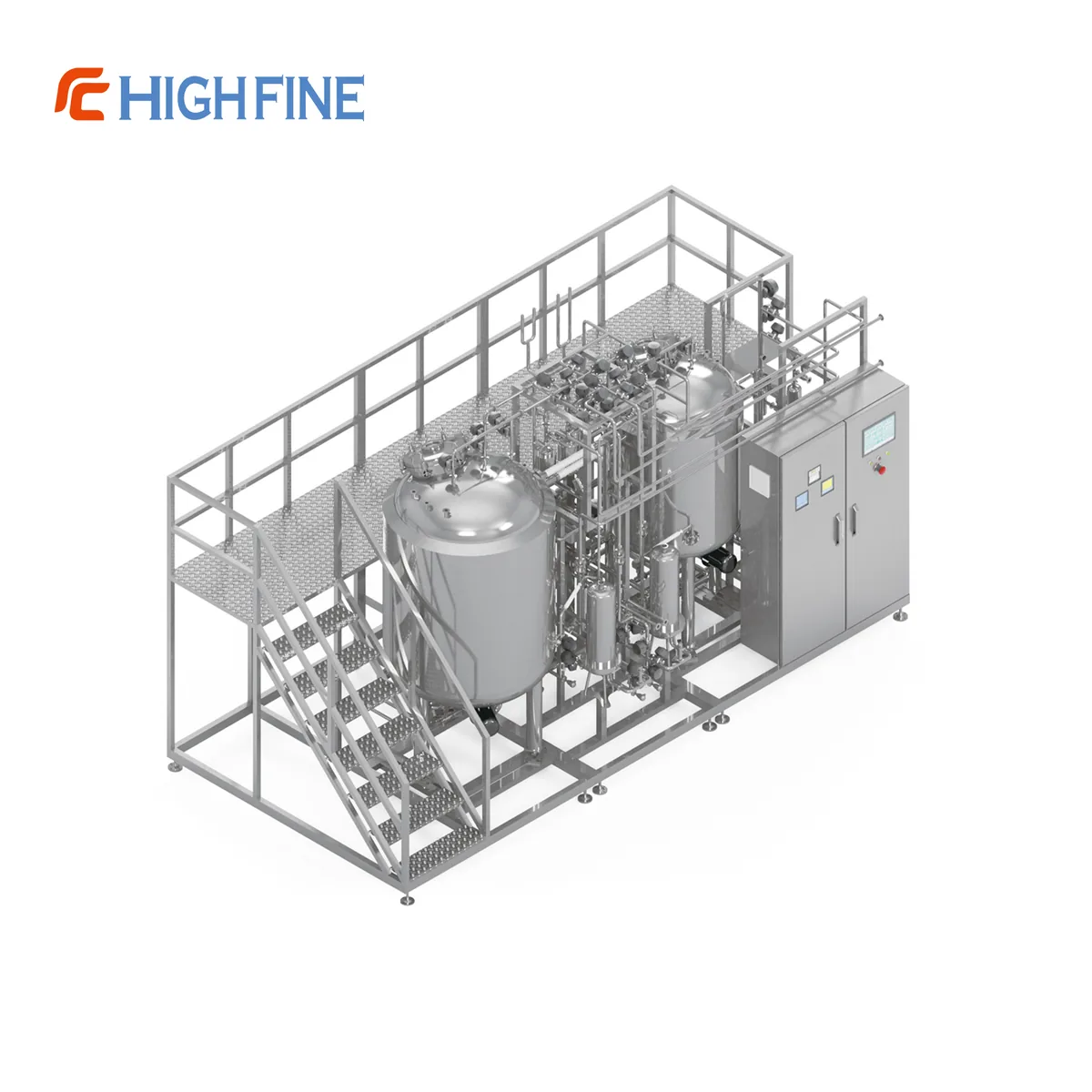
Generation is only the beginning. A WFI water system is judged on what arrives at the point of use, and that is determined by storage and the distribution loop.
Key design principles include:
- Continuous circulation. The loop is kept in constant turbulent motion, with no dead legs and no stagnation pockets. Stagnation is the single most common root cause of excursions.
- Sanitization capability. The loop should be designed for periodic sanitization — commonly by thermal means — without dismantling instrumentation or breaking aseptic boundaries.
- Surface finish and weld quality. Mirror-polished, 316L wetted surfaces with documented weld maps and boroscope records are the baseline for USP and EP compliance. The 0.6 micrometer Ra mirror-polished pipelines offered with the S-Series reflect this requirement.
- Instrumentation and data integrity. Conductivity, total organic carbon, flow and pressure data should be recorded in a way that satisfies your validation master plan, with alarms that are meaningful to operators rather than merely audible.
- Storage tank protection. Tank design should control headspace, prevent ingress of contaminants and support the sanitization regime chosen for the loop.
Compliance: USP, EP and FDA Expectations
A WFI water system is specified against the monograph, not against a brochure. USP and EP both define WFI by its route of production as well as by its chemical attributes, and both require the system to be validated and monitored in a state of control. HIGHFINE systems are designed for USP, EP and FDA compliance. Certificates available upon request.
Compliance is not a document package delivered at handover; it is a property of the installed system. That means the generation skid, the storage tank, the loop and the instrumentation must be qualified together, with sampling points that reflect real use.
Validation and FAT
Factory acceptance testing reduces the risk that commissioning becomes a redesign exercise. The F-Series is supplied with FAT validation, and the S-Series is delivered with full validation documentation. Buyers should expect, at minimum, a documented design qualification, material and surface certificates, instrument calibration records, control system function testing and a clear boundary of supply between vendor and site contractor.
Buyer Selection Checklist
Before requesting a quotation, confirm:
- Required WFI quality standard — USP, EP, JP or a combination.
- Peak and average demand at the point of use, and the diversity factor you intend to apply.
- Available plant steam and electrical capacity at the installation point.
- Product portfolio — vaccines and cell culture products often justify vapor compression.
- Loop topology, point-of-use count, and the sanitization strategy.
- Validation deliverables required by your quality unit.
- Local service response and spare-parts lead time for your region.
- Documentation language and format required for your inspection bodies.
Frequently Asked Questions
Can a WFI water system be expanded after installation?
Expansion is normally handled at the distribution loop and storage stage, with generation capacity sized against a defined growth assumption. Define that assumption early, because it drives the generator selection.
Is vapor compression suitable for a facility without a steam plant?
It substantially reduces steam demand — 70% steam savings versus conventional distillers — which is why it is often chosen where steam capacity is constrained.
What documentation is provided?
Validation documentation is available for the S-Series, and FAT validation for the F-Series. Certificates available upon request.
Where are the systems manufactured?
At No. 379 Zhonghua East Road, Haimen City, Jiangsu Province, China, by HIGHFINE PHARMATECH CO., LTD, a Sino-foreign joint venture founded in 1992.
Next Step
Get a System QuoteTalk to a Water System Engineer
Start the conversation
Get a System Quote
Send your URS; our engineers reply with a P&ID-level proposal.